RTM Audio (Beta)
Store Licences Send a preset
Datasheet · DoublerSTACK 1.4.0 (Beta) · doubling & widening

The doubler
you can see.

Thickens without smearing.

STACK builds a chorus of generated doubles around your track. Every voice is decorrelated and level-staged individually, so you get width and thickness without comb filtering or a phasey mono fold-down. At Amount 0 the output is a bit-exact copy of your dry signal, so it is safe to leave in the chain.

The trial runs 14 days, even where the plug-in's own screen says 5.

↔Single plug-ins $39 · bundles available
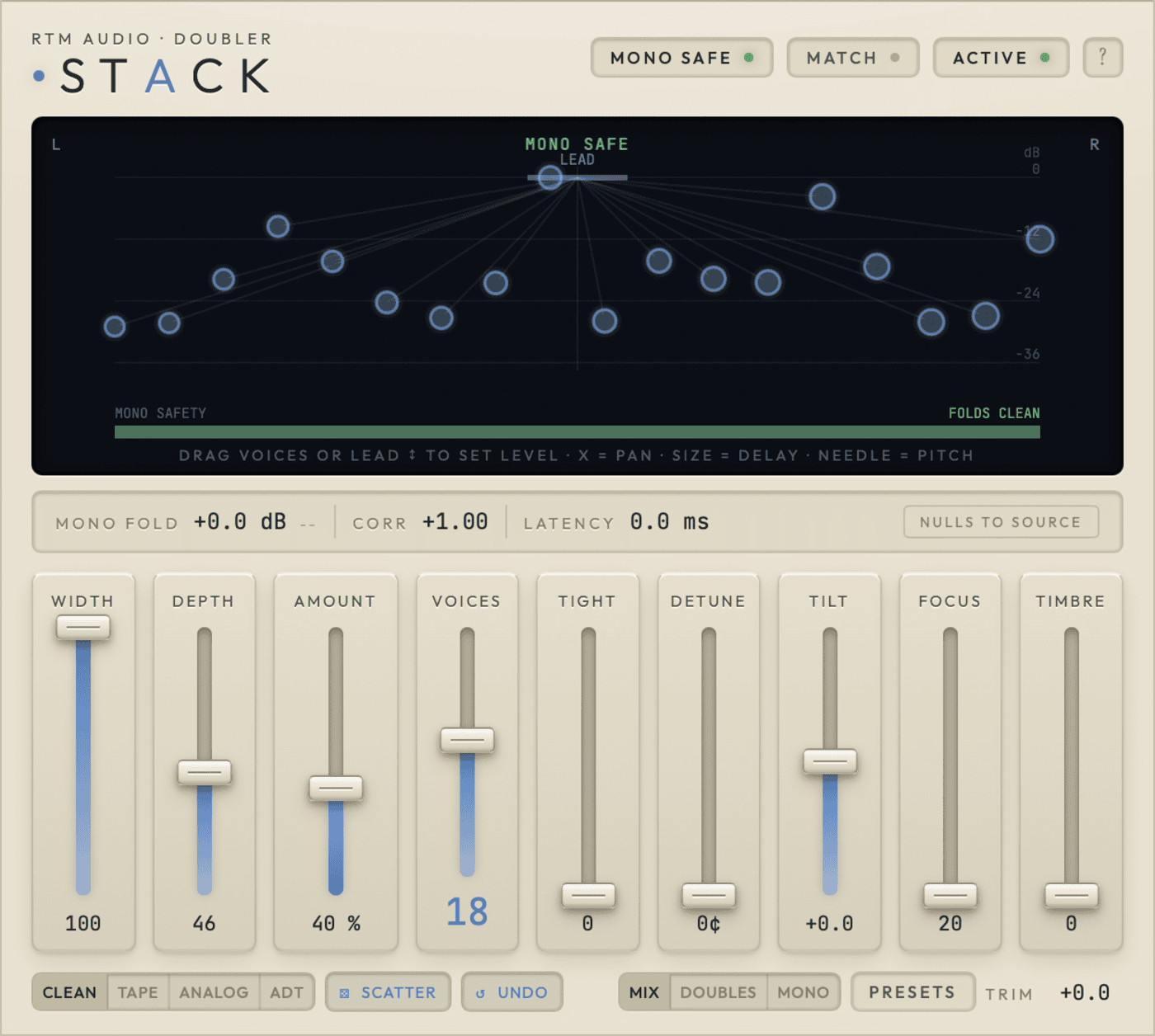
The STACK interface: the Stage showing a LEAD bar with eighteen generated voices scattered across the stereo field, each node's height its level and its needle its pitch, above the mono-fold, correlation and latency readouts and the nine control faders.
Fig. 1 · the Stage · x = pan · y = level · size = delay · needle = pitch
Hear it

Add voices. Then fold it to mono.

Vocal: VocalSet by Julia Wilkins, Prem Seetharaman, Alison Wahl and Bryan Pardo (2018), CC BY 4.0. Trimmed, resampled and processed by RTM Audio.

The idea

A section, not a smear.

A naive doubler copies your track, delays it and detunes it. Do that more than twice and it combs, narrows in mono, and the top end starts to swim. STACK generates each voice as its own performance instead.

What it does

Every voice
is its own take.

Each double gets its own micro-delay, its own static detune (alternating signs so the field stays centred), its own drift in pitch, timing and level, and optional per-voice spectral differentiation, so no two voices stack identically. Push it to 16 or 32 voices and a single take becomes a section: a choir, or a string wall.

What it will not do

Collapse
in mono.

The voices are decorrelated signals, never a polarity-flipped copy, and a delay floor is enforced between them. Fold the mix to mono and you lose the width, never the tone. The Mono Fold and correlation meters read it live, so you are not taking our word for it.

Measured, not modelled

The numbers behind it.

STACK ships with a standalone proof harness. These are its measurements, not adjectives.

122.7 dB
Interpolator SFDR
The detuned voices are resampled with an 8-tap Kaiser windowed-sinc polyphase interpolator. The linear interpolation in older doublers measures 25 to 40 dB, and that gap is the metallic grit you learned to expect from a doubler.
−0.96 dB
Mono fold
Summing the stereo field to mono costs under a decibel, with no cancellation. Not a claim about a preset: the tolerance is enforced by the engine and verified on every build.
0.0 ms
Latency · bit-exact at zero
Zero latency, tracking or mixing. At Amount 0 and in bypass the output is bit-for-bit your input, so it can sit on the channel from the first take to the last.
The controls

Shape the field like a desk.

Nine faders and a stage. Drag a node to set that voice's level, drag it sideways to pan it, scroll it to detune it. The LEAD bar is your dry signal.

01
Voices
1 to 32 generated doubles around the source. 16 to 32 turns one performance into a section.
02
Amount
Wet level of the doubles. 0 = bit-exact dry, no processing at all.
03
Width & Depth
Width spreads the field across the image. Depth steps the outer voices back with pre-delay, a softer top and a small level dip, placing a room behind the lead. Wet only, the dry path stays untouched.
04
Focus
High-pass on the wet voices, 20 Hz to 1 kHz. Everything below stays dry and centred, so the low end holds mono.
05
Tightness & Detune
Tight ADT at low values, loose garage-band doubling at high. Detune is a static per-voice offset up to 50 cents, alternating signs.
06
Timbre & Tilt
Timbre differentiates each voice spectrally so they do not stack identically. Tilt is a Baxandall shelf on the doubles, pivot at 700 Hz.
07
Character
Clean, Tape, Analog or ADT, applied to the voice field only. ADT is a slow tape-machine varispeed wobble, the classic sixties double.
08
Seed
Re-roll the humanization for a different, equally valid field. The same seed always rebuilds the same take.
09
Match, Solo, Mono
K-weighted loudness-matched A/B so a fatter sound is never just a louder one. Solo the doubles, or fold to mono to check the safety, in one click.
The details

Specifications

Type
Multi-voice doubler with per-voice staging, up to 32 generated voices
Interpolation
8-tap Kaiser windowed-sinc polyphase, measured 122.7 dB SFDR
Mono safety
Enforced delay floor and decorrelation, mono fold −0.96 dB with no cancellation, live fold and correlation meters
Latency
Zero. Bit-exact at Amount 0 and in bypass
Colour
Clean / Tape / Analog / ADT, wet only. Analog is 2× oversampled so its soft clip cannot alias
Formats
macOS: AU · VST3 · AAX · Windows: VST3 · macOS 10.15+ (Intel) · 11+ (Apple Silicon) & Windows 10/11
Licence
One-time, activates on two machines. No subscription. Activates online, and needs an internet connection to authorise.
Status
Out now · v1.4.0
Try it free

Hear STACK on your own session.

Own it outright, or drop it on a live session and run the complete plug-in free for 14 days. Every feature unlocked, no card, just a free account.

$39 in US dollars, or €35 in Europe. The price you see is the price you pay: any local tax is already inside it. Checkout is handled by Moonbase, our merchant of record, on their own page at moonbase.sh.

Not for you? Ask for a full refund within 14 days of purchase.

or start a free 14-day trial, free account, no card:

The trial runs 14 days, even where the plug-in's own screen says 5.

Free account for the trial · AU · VST3 · AAX on Mac, VST3 on Windows · macOS 10.15+ (Intel) · 11+ (Apple Silicon) · Windows 10/11