เปิด Match level แล้วไฟล์ที่ดังกว่าระหว่าง A กับ B จะถูกลดลงมาเท่ากับความดังที่วัดได้ของไฟล์ที่เบากว่า ไฟล์ที่เบากว่าอยู่ที่ระดับเดิมของมัน และไม่มีไฟล์ใดถูกเพิ่มระดับ สลับด้วย A, B หรือ S แล้วตำแหน่งเล่นจะอยู่ที่เดิม ไม่ว่าจะอยู่ในลูปหรือไม่
ไฟล์ที่ดังกว่าถูกลดลง ไม่มีอะไรถูกเพิ่ม
Linked time ใช้ตำแหน่งเล่นเดียว
ลูปช่วงหนึ่งด้วย L
ซูมสเปกตรัม
ซูมเข้าไปที่ความถี่ที่คุณกำลังตัดสิน
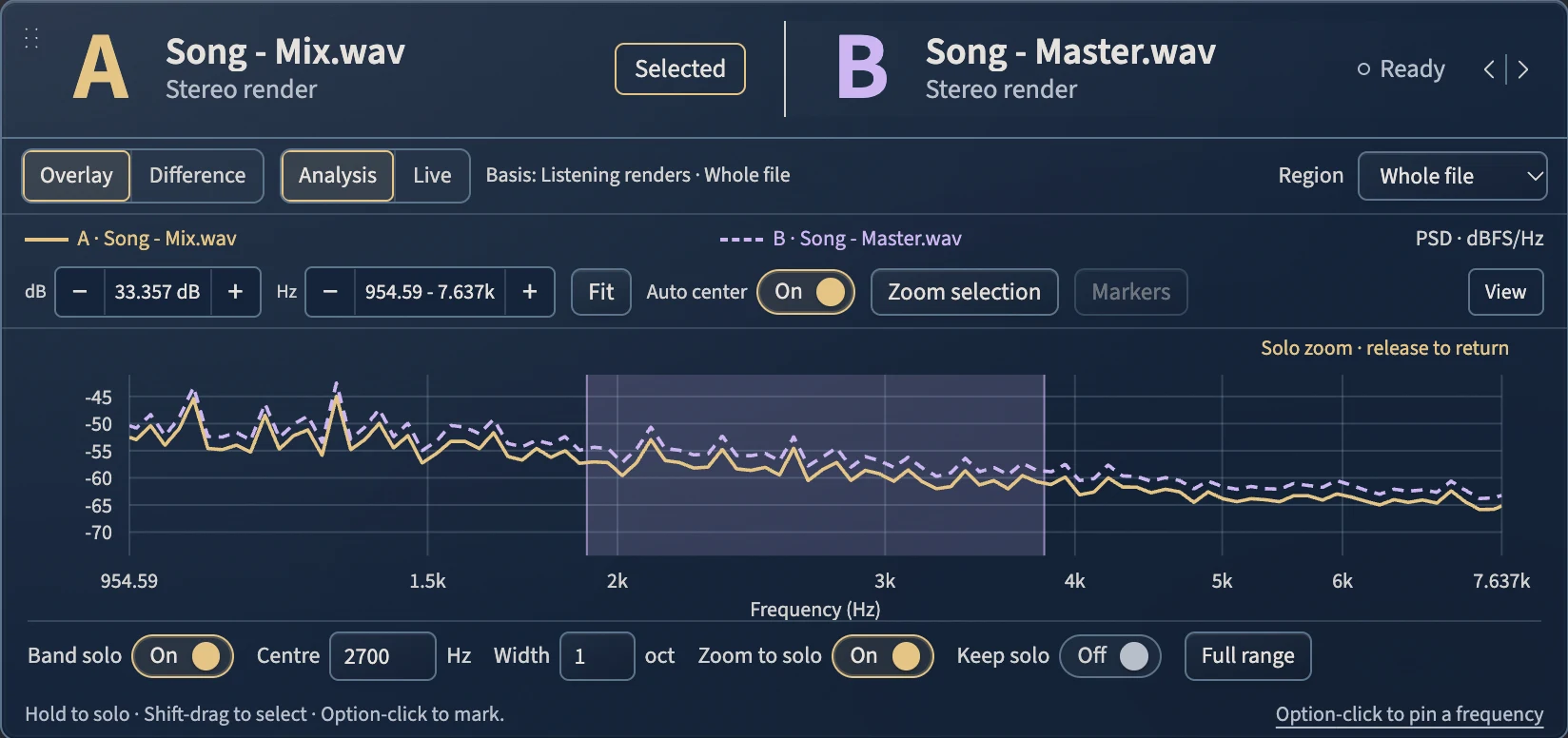
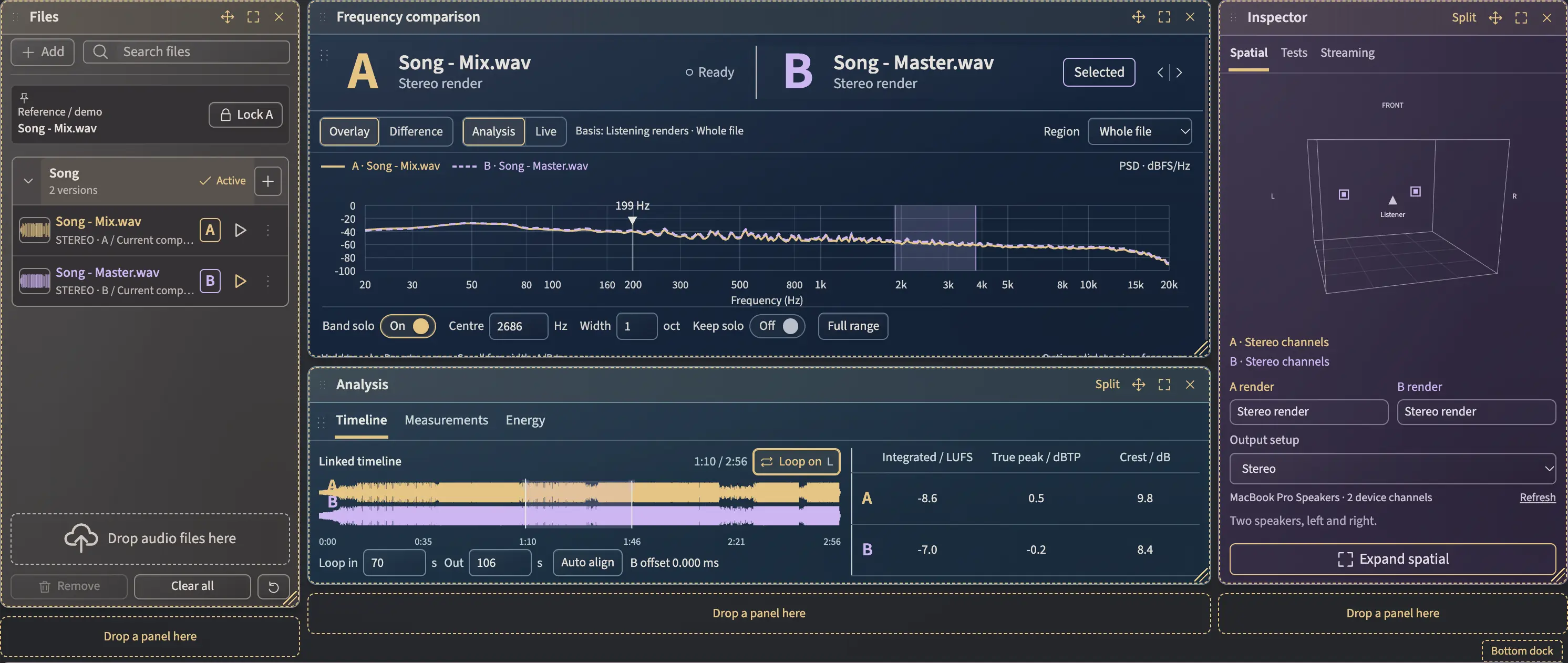
ซูมสเปกตรัมได้ทั้งแกนความถี่และแกนระดับเสียง กด Shift แล้วลากผ่านช่วงหนึ่ง จากนั้น Zoom selection จะขยายช่วงนั้นให้เต็มกราฟ Fit ปรับระดับให้พอดีกับสิ่งที่อยู่บนจอ และ Auto center ทำให้เส้นอยู่ในมุมมองเสมอ เมื่อโซโลย่านความถี่ มุมมองจะตามไป ปล่อยโซโลแล้วมุมมองจะกลับไปที่เดิม การซูมเปลี่ยนแค่มุมมอง ไม่เคยเปลี่ยนเสียงหรือค่าที่วัดได้
จาก 20 Hz ถึง 20 kHz ลงไปจนถึง 1/24 ออกเทฟ
กด Shift แล้วลาก จากนั้น Zoom selection
มุมมองตามการโซโลและกลับคืน
แบนด์โซโล
A/B บนแบนด์เดียว
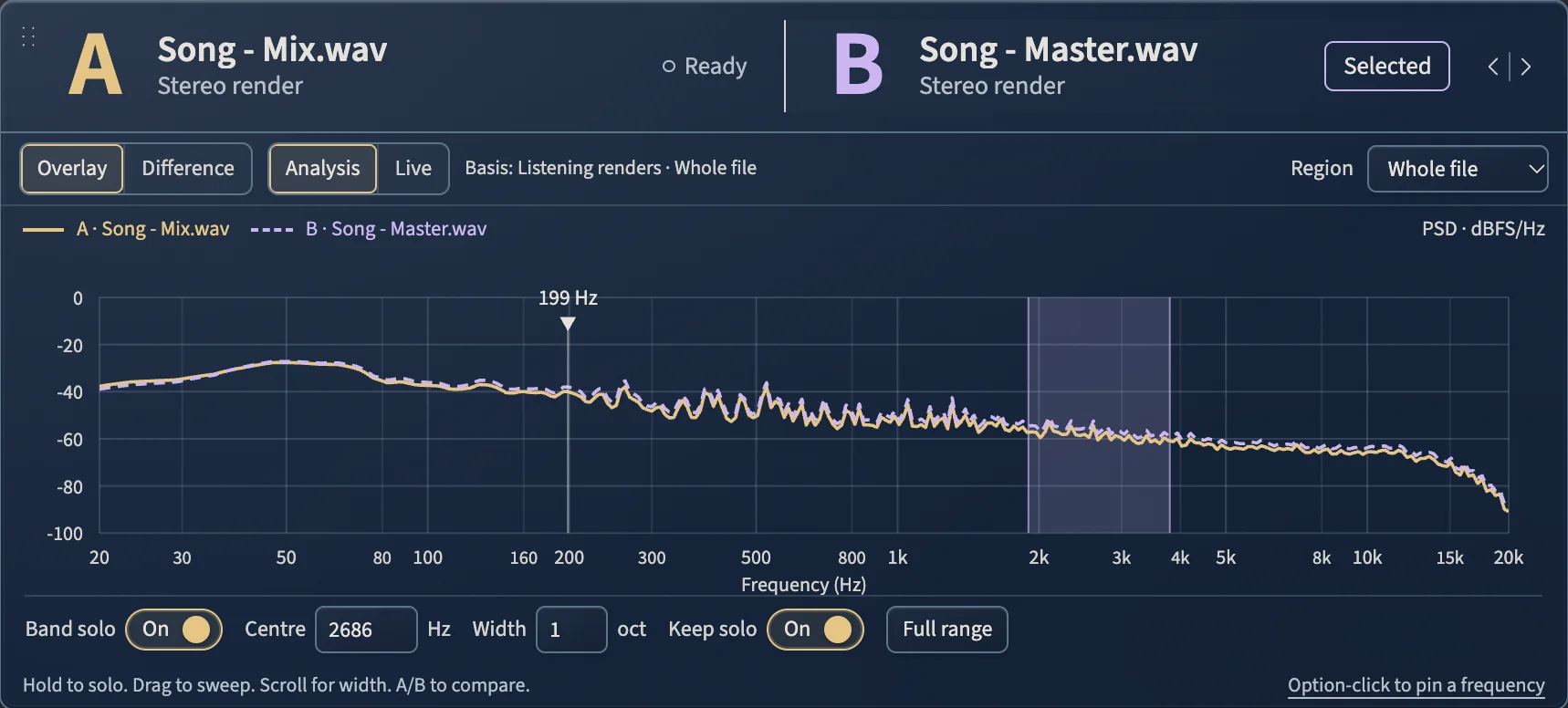
กดค้างบนสเปกตรัมแล้วจะได้ยินเฉพาะแบนด์นั้น ลากเพื่อกวาด เลื่อนเพื่อเปลี่ยนความกว้าง และกด A, B หรือ S เพื่อสลับแหล่งเสียงภายในแบนด์เดียวกันในจังหวะเดียวกัน พิมพ์ความถี่กลางเป็น Hz และความกว้างเป็นอ็อกเทฟ หรือใช้ Keep solo เพื่อล็อกไว้ Option-คลิกเพื่อปักหมุดความถี่ที่ต้องการกลับมาดู
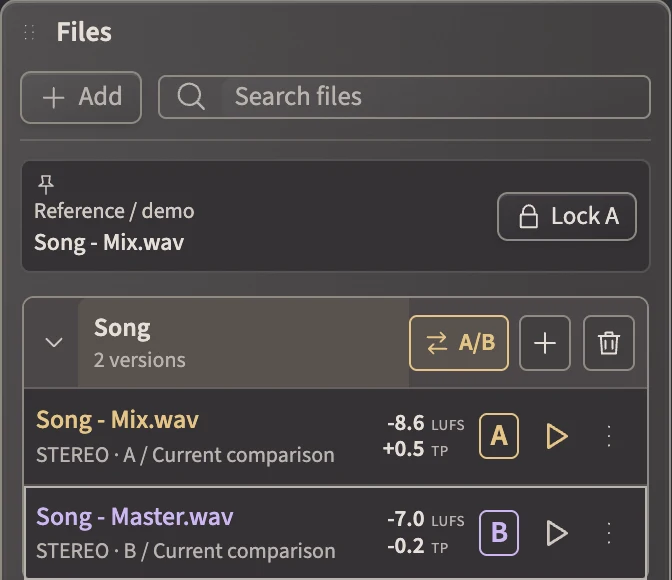
ทุกไฟล์ในรายการแสดงความดังและ true peak ของตัวเอง วางไฟล์หนึ่งลงบนอีกไฟล์เพื่อซ้อนเป็นเวอร์ชันของเพลงเดียวกัน โดยแต่ละสแต็กมี A/B, Add version และ Clear ของตัวเอง Lock A จะคงไฟล์อ้างอิงหรือเดโมไว้ที่ A ขณะที่คุณไล่ฟังเพลงและเวอร์ชันอื่นทั้งหมดใน B
LUFS และ true peak ในทุกไฟล์
วางไฟล์หนึ่งบนอีกไฟล์เพื่อซ้อน
Lock A สำหรับเพลงอ้างอิงหรือเดโม
เลย์เอาต์ของคุณเอง
Move every panel where you want it.
Press Arrange and every panel gets its handles: files, spectrum, timeline, measurements, spatial, tests, streaming and the player. Drag one to a new place, resize it, float it, split a combined panel into its parts or hide it. Save the layout as a workspace, set it as your default, and every project keeps its own.
ย้าย ปรับขนาด ลอย แยก ซ่อน
บันทึกเลย์เอาต์เป็นเวิร์กสเปซ
ทุกโปรเจกต์เก็บเลย์เอาต์ของตัวเอง
การทดสอบแบบบลายด์
เดาก่อน แล้วค่อยดู
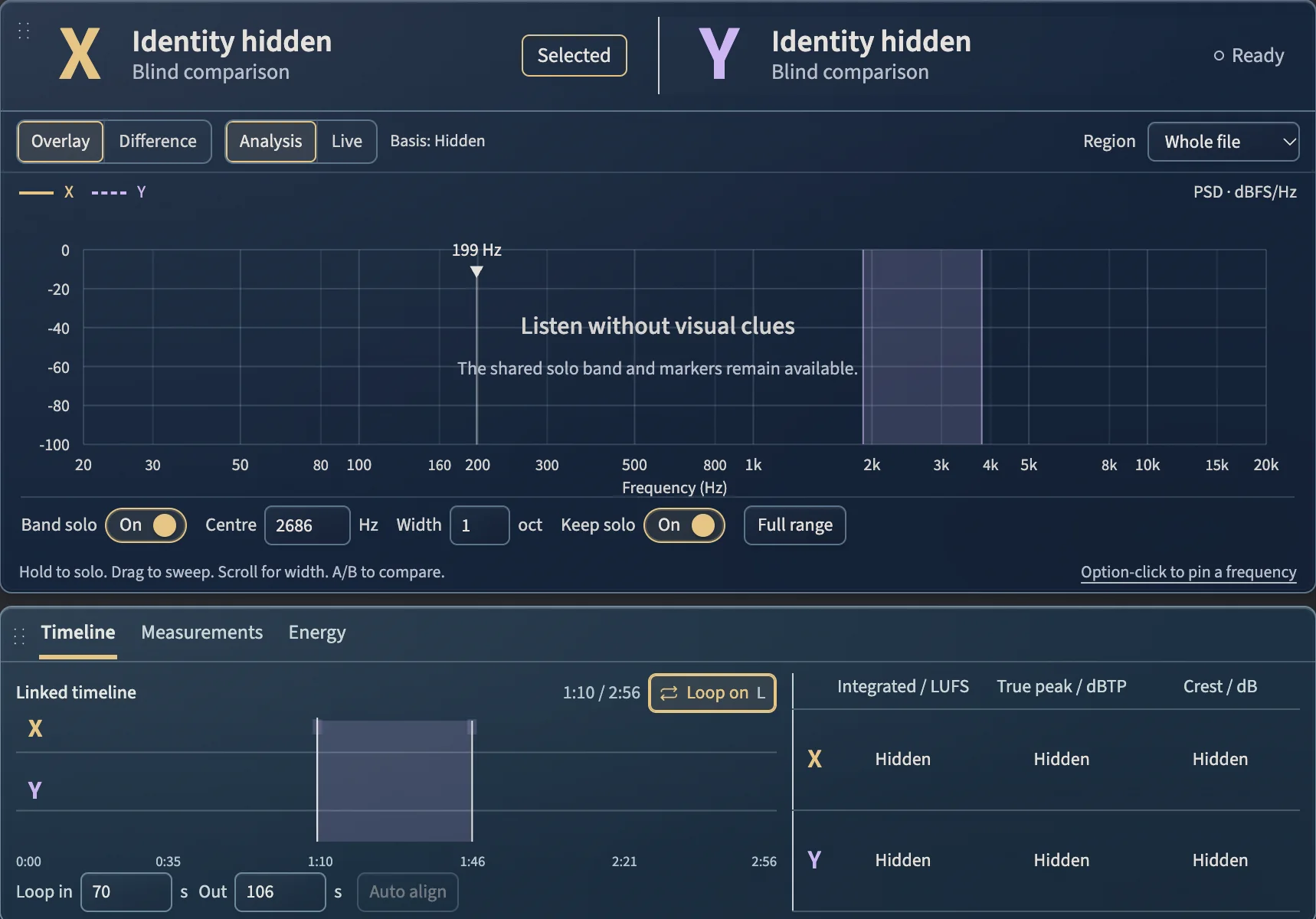
Shift+B ซ่อนชื่อ เวฟฟอร์ม ค่าที่วัดได้ และเบาะแสด้านพื้นที่เสียง แล้วสุ่มแจก A และ B เป็น X และ Y เปรียบเทียบด้วย X, Y หรือ S บนลูปเดิมและแบนด์โซโลเดิม เปิดเผยเมื่อเลือกแล้ว และเริ่มรอบใหม่เพื่อสุ่มอีกครั้ง
ซ่อนชื่อและค่าที่วัดได้
สุ่ม X และ Y ทุกรอบ
เปิดเผย แล้วเริ่มรอบใหม่
ซ้อนทับหรือผลต่าง
วาด A และ B บนกราฟเดียว หรือลบ B ออกจาก A เพื่อดูว่าฝั่งไหนมีพลังงานมากกว่าตรงไหน บนสเกลที่ซูมได้ Analysis เฉลี่ยทั้งไฟล์หรือลูป ส่วน Live ตามตำแหน่งเล่น
สองโทนของเลย์เอาต์เดียวกัน หรือตามระบบ Space เล่น A และ B เลือกแหล่งเสียง S สลับ L ลูป
COMPARE 1.1
Measure the job, not just the sound.
COMPARE 1.1 adds 29 modules for the work around the mix: null tests, EQ match, stems that must add up, deliveries that must come from the master, codec overs, mic delay, esses per minute, and tests for the plug-ins and gear you build. Each one measures and explains how to read it. None of them tells you what is good.
On Mac now. The Windows version follows.
29modules
5roles
20workspace presets
12tabs per project
A role workspace: three modules beside the spectrum, each showing up to five readings. Focus opens one over the whole window.
Hidden until you want them
Modules stay out of the way. Add one from the Modules menu, or open a role workspace and get three at once.
Tabs that talk to each other
Up to 12 named tabs per project, three modules per tab. Every tab shares the same files and results.
A guide in every module
How to use it, what it shows, how to read it. Measurements and explanations, never a verdict.
Mastering 9 modules
Null & DiffLines B up with A and shows what changed, where, and by how much.
Family CheckWhether each delivery (clean, instrumental, MP3) comes from the hero master.
Delivery QCClips, overs, DC, silence, real bit depth, bandwidth, hum and clicks in one file.
Codec OversWhere AAC and Opus encodes of the master go over, and by how much.
Mastering DeltaWhat mastering changed between a mix and its master: level, tone, width and dynamics.
Stereo & PhaseWidth and correlation per band, and where the mono sum loses level.
Album SequenceThe loaded masters as an album: order, gaps and level track to track.
Vinyl PremasterSide length, low-end phase, sibilance and inner-groove readings for a cut.
Atmos ConformanceThe ADM master folded to stereo against the stereo master: level, length and timing.
Mixing 5 modules
EQ MatchThe EQ that brings B toward A, band by band, as points you can drag. Listen to B + EQ before you touch your own EQ.
Stem & Alt-MixDo the stems add up to the mix, and what an alt mix leaves out.
Vocal BalanceHow loud the vocal sits over the music, from a mix plus its instrumental or a cappella.
Band PunchPunch and crest per octave, A against B, on the same hits.
Low-End LabLow hits, held low notes and their pitch, and the pump of the low end.
Recording 2 modules
Mic AlignDelay, polarity and comb loss between two mics on one source.
Sibilance & PlosivesEsses and pops per minute of singing, take against take.
Producer 3 modules
Sections & LiftThe song's parts, lettered, and how much one part lifts over another.
Live TipsWhile A plays, where its balance sits against B or a profile, window by window.
ProfilesA bank of your own measured reference tracks, and where yours sits inside it.
Designer 10 modules
For people who build plug-ins and gear. Mac first.
Frequency & PhaseLevel, phase and delay per frequency, left and right.
Harmonics & DistortionHarmonics added at each level, even and odd, and THD.
Latency CheckThe delay a plug-in reports against the delay it really has, at each rate.
Dynamics CurveMeasured threshold, ratio, knee, attack and release.
AliasingTones folded back below Nyquist, and how strong.
IntermodulationNew tones made when two tones pass through together.
Noise, Idle & TailsNoise and DC at silence, and how long it rings on.
Plugin A/BTwo plug-ins or two versions, on test signals or music.
Music ThroughA section of a real song through the plug-in, then before and after as A and B.
Torture TestEvery sample rate and block size: errors, silence and results that change.
The full tour of the app and the plug-in: files, Spotify and your DAW, Atmos and other plug-ins, with the difference chart, loudness, delivery checks and plug-in measurements. Pick a chapter to jump straight to it.
Read the transcript
Intro
This is RTM COMPARE. It plays your versions side by side, at the same point and at the same level, and it shows you what's really different between them. It comes two ways, and you get both. There's the app, which is where you do the deep work, and there's the plug-in, which sits on your mix bus in your DAW. One licence unlocks both, on Mac and Windows, and you can try it free for fourteen days. We'll learn everything in the app first, because the plug-in works the same way.
A tour of the screen, and where sound goes
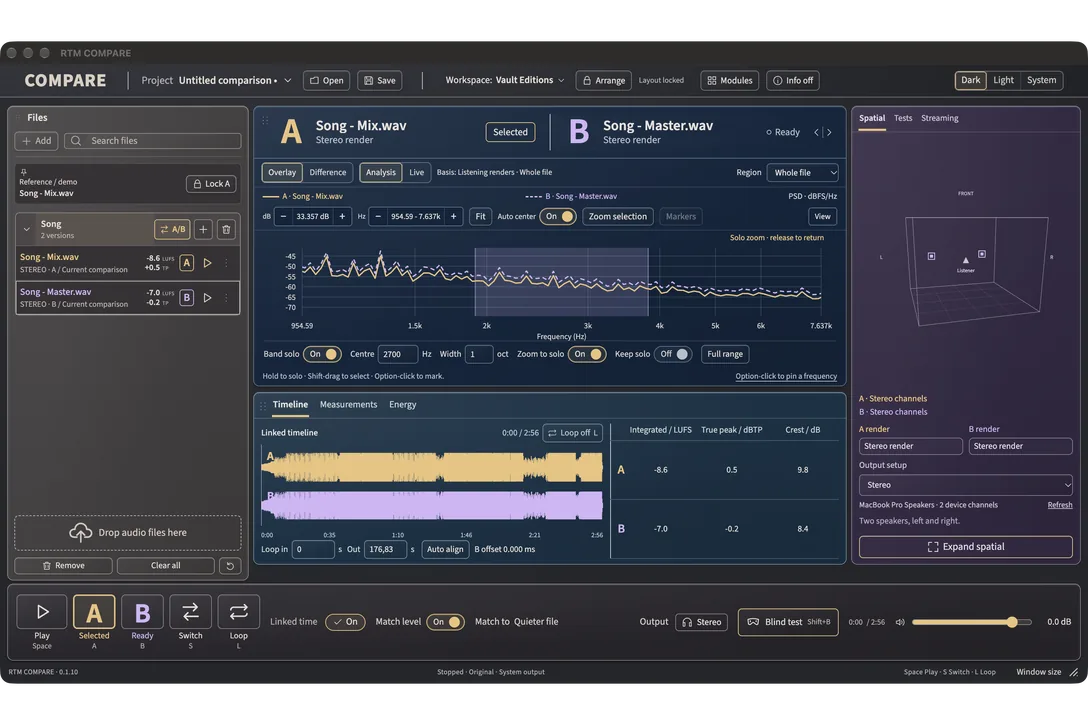
Here's the screen. Your files go on the left. In the middle are A and B, the two things you're comparing, with their frequency chart, and under it the timeline and the numbers. On the right are the spatial view, the listening tests and the streaming preview, and the transport is along the bottom. Sound comes in from files, from other apps on your Mac, or from your DAW through the plug-in, and it goes out through whatever output your Mac is using, at the level of this Output knob. Whatever you do in here, your files are never changed.
Listen fairly: Match level, A/B, blind test
So let's load a mix and its master. As soon as they're read, each file shows its loudness and its true peak, and the first one becomes A, the second becomes B. Space plays, and S switches between them at exactly the same point in the song. Now turn on Match level. COMPARE turns the louder one down to the quieter one, it never boosts anything, so now you're comparing sound, not volume. Lock A to keep your reference in place, drag on the timeline to loop the chorus, and if one file starts a little later, Auto align lines B up to A without stretching anything. And if you don't trust your ears, press Shift B. A and B become X and Y, the names and numbers disappear, you pick the one you like, and Reveal tells you which one it was.
Versions: stacks, replace and re-read
Most songs have more than two versions, so here's how to keep them tidy. Drag one file onto another and they become a stack, one song with all its versions together. Choose Compare on the stack, and the mix goes to A and the newest master to B, and the older versions wait in the history, one click away. Got a new bounce? Replace file swaps it in the same slot and measures it again, and if you bounced over the same file, just press R, or Re-read, and everything updates. Stacking never moves or deletes your files.
See the difference: chart, zoom, band solo
Now let's see it. The chart shows A as a solid line and B as a dashed line on the same scale, and Difference shows A minus B, so above zero A has more, and below zero B has more. You can zoom right into the chart: scroll to zoom into the frequencies, hold Shift and scroll to zoom the level, Auto centre keeps the curve in the middle, and Fit shows everything again. Zooming only changes the picture, never the sound. And here's the best part, hold and drag on the chart, and you only hear that area. Turn on Keep solo and press S, and you're comparing just that band, and with Zoom to solo on, the chart zooms right into it. Under the chart you've got the numbers side by side: loudness, the loudest three seconds, true peak, loudness range, crest, and a BPM and key estimate. Analysis is the average of the whole file or your loop, and Live follows the playhead as it plays.
Will it translate? Car, club, phone, streaming
Last step on the same pair: will it translate? Tests lets you hear both versions in a car with cabin noise, in a club, or on a phone with a mono speaker. They're approximations, not one particular car, but if your vocal disappears on the phone, you'll hear it here first. And Streaming preview turns both down the way a streaming service would, or runs them through AAC or Opus, all on your computer, nothing is uploaded.
Stream from Spotify or your DAW
So far we've used files, but you don't even need one. Click Stream, and you'll see every app that's playing sound on your Mac. Tick the one you want, Spotify or your DAW, and it streams into COMPARE while you keep hearing it as normal. The first time, macOS asks if COMPARE can record system audio, so allow it, and if you missed that, it's in System Settings, Privacy and Security, Screen and System Audio Recording. Now open the picker next to B, and the app is right there under Apps. Choose it, and B is now whatever that app is playing, measured live, with its curve right on the chart. And nothing is recorded, it's only read while it plays.
The plug-in in your DAW
And if you'd rather stay in your session, there's the plug-in. Put COMPARE on your mix bus, and your live mix becomes A. Load a reference as B, and it plays in time with your session, so when you jump around the timeline, the reference follows. Everything you just learned is here, Match level, the chart, band solo, EQ Match, Blend and the Car, Club and Phone tests, with the same keys: A and B, S to switch, Shift B for a blind test. The heavier tools stay in the app: streaming from other apps, the streaming encodes, the plug-in analysis and Atmos.
Make room: layout, tabs and workspaces
Everything else in COMPARE lives in modules, and COMPARE is modular, so first let's make room. Click Arrange, and you can drag any panel somewhere else, resize it or float it, then Done arranging. You can add any module from the Modules menu, just type what you want to check, like punch or phase or vinyl. But the best way in is tabs. Click the plus, pick a workspace for your job, and it opens in its own tab with the three modules that job uses most, with room to work. Your files are shared across every tab, each tab keeps its own layout, and you can have up to twelve. Save layout keeps the tab you're in, Save setup keeps all your tabs, and saving the project remembers your files, your A and B, your loop and your layout. Save portable copy puts the audio inside too, so you can send it to someone.
For producers
For producers, open the Producer workspace. Sections & Lift maps your song into its parts and shows how much the chorus lifts over the verse, so load a reference as B and you can see if your drop lifts as much as theirs, in dB. Null & Diff tells you exactly what changed between two bounces, and Low-End Lab and Band Punch show you what's going on at the bottom and how hard each octave hits.
For mixers
For mixers, the Mixing workspace. Vocal Balance measures how loud the vocal sits over the music, from the mix and its a cappella. Stem & Alt-Mix checks what each alt mix leaves out before you send anything to the label. EQ Match shows the EQ that would bring B toward A, Live Tips shows where your mix sits against a reference while it plays, and Stereo & Phase shows width per band and where you lose level in mono. And if you record, Mic Align and Sibilance & Plosives are in the Recording workspace.
For mastering engineers
For mastering, start with Mastering Delta. It shows exactly what the master changed against the mix, in level, in tone, in width and in dynamics, all in one place. At the end of the job there's Family Check. Load the approved master and every file you made from it, the sixteen bit, the MP3, the clean, the instrumental, and it checks that each one really came from that master. Delivery QC checks a file for clips, overs, DC, silence, real bit depth and clicks in one go, and Codec Overs shows where your master goes over zero dB true peak once it's encoded. And there's Vinyl Premaster and Album Sequence when you need them.
Atmos
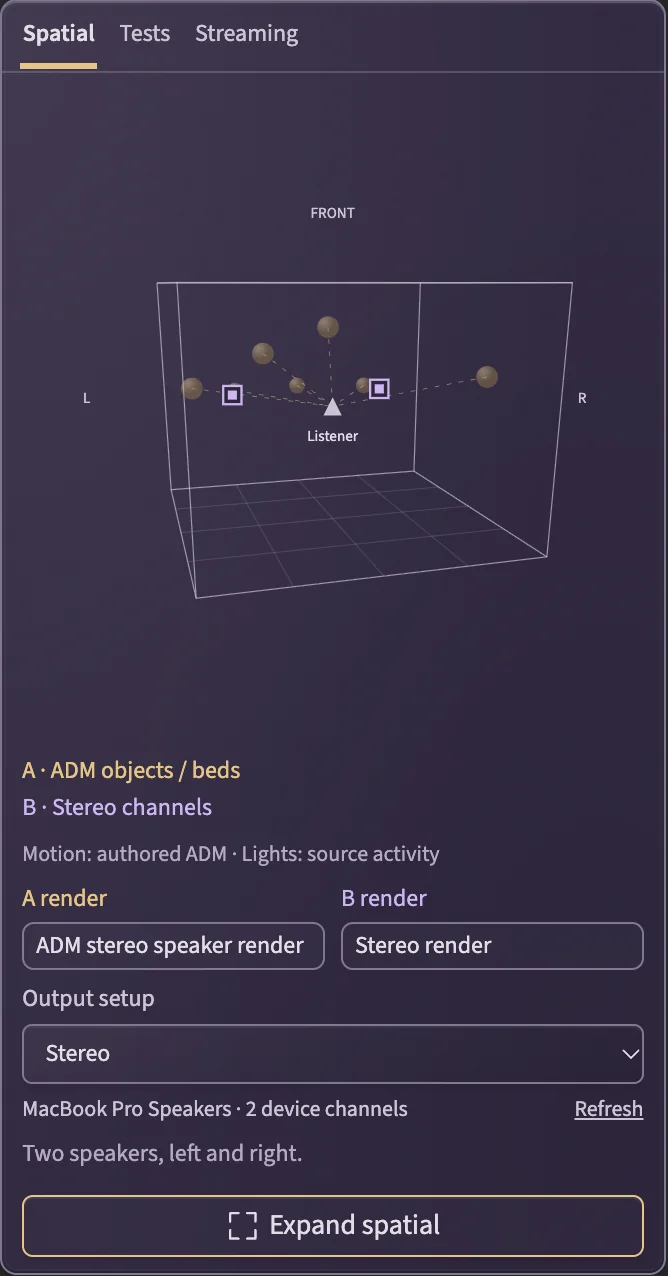
Working in Atmos? Load the ADM file and the stereo master, and you can A/B them on headphones or on speakers, all the way up to 7.1.4, with the objects moving in this 3D view. And Atmos Conformance folds the Atmos master to stereo and checks it against your stereo master, in level, length and timing.
For plug-in and gear designers (Designer)
And the last workspace is for people who build plug-ins or gear. Designer lets you pick any Audio Unit or VST3 on your Mac and measure what it really does. Here's our PEAK2. Frequency & Phase sends a sweep through it, and it comes back flat. Latency Check shows the delay a plug-in reports against the delay it really has, at every sample rate, and here they match everywhere, which is exactly what you want to see. Harmonics & Distortion shows what it adds. Then in Dynamics, I turn the drive up, and Dynamics Curve measures the real threshold, knee, attack and release, not what the knobs say. Noise, Idle & Tails checks what it does at silence and how much CPU it uses. There's also Aliasing, Plugin A/B to compare two plug-ins or two builds, and a Torture Test for every sample rate and block size, and with a loop cable you can measure your hardware too.
Wrap-up
So that's RTM COMPARE: listen fairly, see the difference, and go as deep as your job needs. The app and the plug-in, on Mac and Windows. Try it free for fourteen days, the link's below, and go hear what's really different, and what's just louder.