The problem
That is why a chorus reads as an effect and a real double reads as an arrangement. Modulation applied to a single source produces a periodic relationship, and the ear is very good at hearing periodicity as a process rather than as a person. Convincing doubling is built from independent, aperiodic variation per voice.
The failure mode to watch is mono. A widened part that collapses when the mix is summed is not wide, it is temporarily wide, and the places your record will actually be heard, a club system, a phone speaker, a laptop, a mono compatible broadcast chain, are exactly where the collapse shows up. Mono safety is a construction property, not a setting to check afterwards.
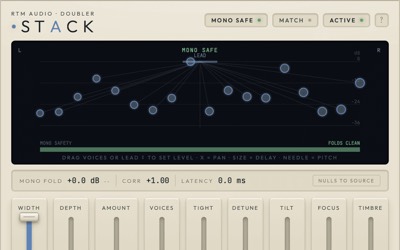
The last thing is control. If you cannot see how many voices are running, where they sit, and what each one is doing, you are tuning a black box by ear at the end of a long session. Voices you can see are voices you can commit to.
Two checks. Sum to mono and listen for what disappears. If the width goes and takes the body with it, the effect was phase, not performance. Then solo the added voices on their own: real doubling voices sound like plausible takes, each slightly wrong in its own direction. If they sound like one voice through a modulated delay, that is because they are.